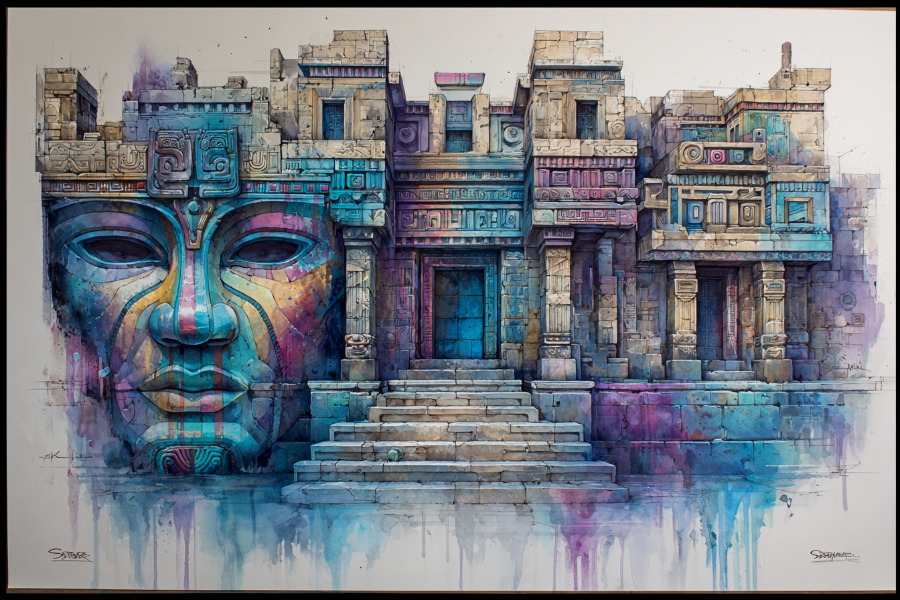
by Constantin François de Chassebœuf, Comte de Volney
At The Sovereign Mind, we are committed to exploring ideas that illuminate the path to earned sovereignty—self-governance rooted in moral clarity, accountability, and alignment with divine principles. Few works resonate with this mission as deeply as The Ruins, or a Survey of the Revolutions of Empires (1791) by Constantin François de Chassebœuf, Comte de Volney. Written in the fervor of the French Revolution, this philosophical masterpiece offers a timeless meditation on the rise and fall of civilizations, the nature of human governance, and the spiritual truths that unite us all. For those seeking to understand what it means to govern oneself and contribute to the common good, Volney’s work is both a cautionary tale and a call to action.
A Journey Through History’s Lessons
Volney, a French philosopher and orientalist, begins The Ruins with a poignant scene: the narrator, standing amidst the ruins of Palmyra, contemplates the decay of once-great empires. This sets the stage for a sweeping exploration of why civilizations flourish and falter. Volney argues that empires rise when governments allow “enlightened self-interest” to thrive—a principle that echoes our belief in earned sovereignty, where individuals govern themselves with wisdom and responsibility for the collective good.
Yet, Volney’s analysis is unflinching: empires fall when they abandon natural law, equality, and liberty. His critique of political and theological ideologies as sources of division and oppression aligns with The Moorish Alliance’s commitment to correcting historical fraud and promoting peace through clarity. By examining the cycles of human history, Volney invites us to reflect on our own role in shaping a just society—not through conflict, but through the disciplined practice of self-governance.
Sovereignty and Spiritual Unity
One of Volney’s most radical contributions is his vision for unifying humanity through the recognition of common truths underlying all religions. In the final chapters, he reviews the history of major faiths, proposing that their shared moral principles could bridge divides if separated from dogmatic institutions. This resonates deeply with our mission at The Sovereign Mind to integrate spirituality and science in pursuit of harmony. Volney’s call for the separation of church and state as a path to world peace mirrors our belief that true sovereignty is earned by aligning with divine virtues—love, truth, and compassion—without the distortions of human-made hierarchies.
Volney’s controversial stance on the Christ myth theory, suggesting Christianity as an amalgamation of ancient mythologies, may challenge some readers. Yet, his allowance for an obscure historical figure woven into solar mythology invites us to focus on universal truths rather than divisive doctrines. For a Safir of The Moorish Alliance, this perspective underscores the importance of sincerity (Ikhlās) and remembrance (Dhikr), as we seek to embody divine principles in our actions, not merely in dogma.
Relevance for Today’s Seekers
Volney’s insights are strikingly relevant in our polarized world. His rejection of Jean-Jacques Rousseau’s Social Contract—and its implications for centralized, coercive governance—aligns with our critique of systems that undermine individual agency. His emphasis on enlightened self-interest as the foundation of thriving societies speaks to our call for individuals to govern themselves with clarity and accountability, fostering a body politic that reflects the virtues of its people.
Moreover, Volney’s observations on the contributions of early Nile Valley Africans to civilization challenge Eurocentric narratives, reminding us to honor the diverse roots of human progress. This aligns with The Moorish Alliance’s mission to correct historical inaccuracies and uplift all people through truth and dignity.
A Call to Demonstrate
The Ruins is not just a historical meditation; it is a blueprint for earned sovereignty. Volney’s accessible prose, described by readers as a “page-turner,” invites us to reflect on our own capacity to govern ourselves and our communities. His work challenges us to demonstrate—through actions, not protests—what good governance looks like. As Safirs, we are called to walk in peace, educate with clarity, and serve humanity with love (Mahabbah), just as Volney envisioned a world united by shared truths.
Final Thoughts
For readers of The Sovereign Mind, The Ruins, or a Survey of the Revolutions of Empires is a must-read. It is a profound exploration of self-governance, a critique of systems that erode liberty, and a hopeful vision for a unified humanity. Volney’s work reminds us that sovereignty is not claimed but earned—through the daily practice of aligning our actions with the Creator’s principles. We recommend seeking out the Jefferson-Barlow translation (first U.S. edition, 1828) for its historical significance, but any edition will inspire those committed to peace and progress.
Join us at The Sovereign Mind as we continue to explore ideas that empower us to govern ourselves and build a world of harmony. Let Volney’s Ruins be a guide on your journey to earned sovereignty.
 The Sovereign Mind