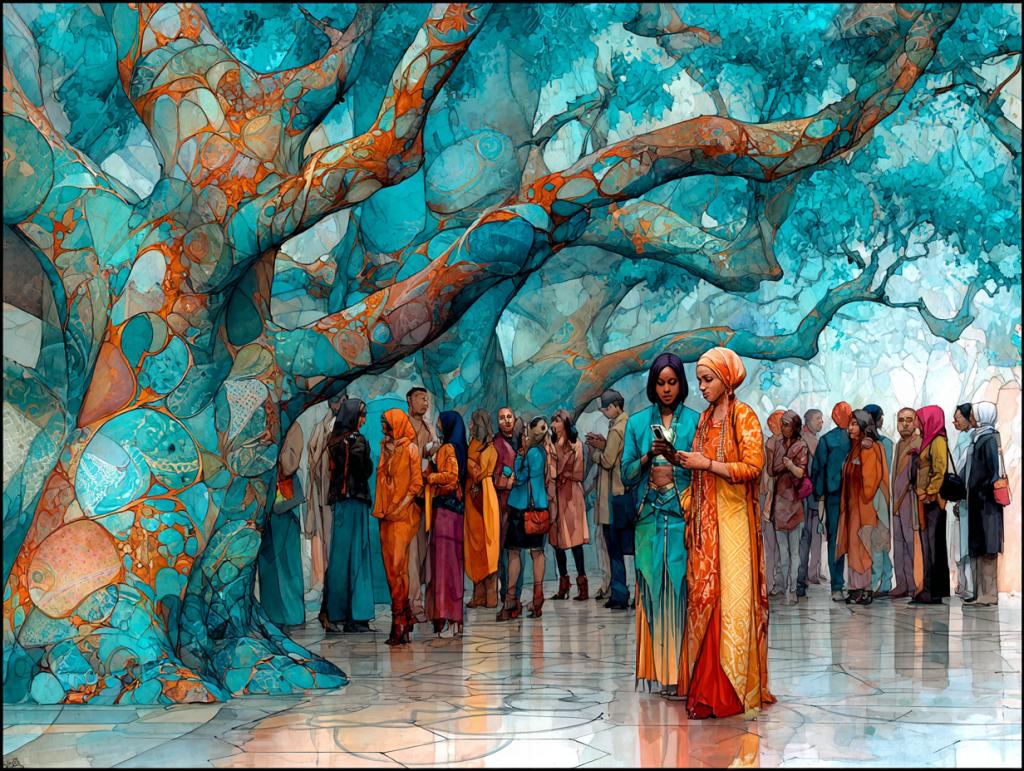
Welcome back to The Sovereign Mind, where we journey together toward earned sovereignty through self-governance, moral clarity, and peaceful living, inspired by The Moorish Alliance of Friendship and Peace. Today, we are going to briefly switch gears from our planned post on the importance of storytelling in earned sovereignty, so that we may reframe the concept of sovereignty from the perspective of a Prophet of Islam—one who, as a divine messenger, embodies the belief that true sovereignty flows solely from the Creator and is realized only when divine governance is woven into the fabric of human experience and expression. Drawing from Islamic teachings, where sovereignty belongs to Allah alone, we explore how this divine authority is not distant or abstract but made manifest through intentional human actions, virtues, and stewardship. This aligns deeply with our blog’s mission: sovereignty is earned, not claimed, by aligning our lives with divine wisdom for the common good.
Sovereignty as Divine Trust: The Prophet’s Vision
In the Islamic tradition a Rasul of Allah, like Muhammad, serves as the ultimate exemplar of grounding divine sovereignty in human affairs. Sovereignty, or hakimiyyah, is not a human invention or inheritance but an exclusive attribute of Allah, the All-Wise and All-Knowing. As the Qur’an declares, “To Him belongs the dominion of the heavens and the earth” (Surah Al-Baqarah 2:107), emphasizing that all authority originates from the Divine. Prophets do not possess sovereignty themselves but act as conduits, revealing God’s laws to humanity so that divine governance can be lived out in daily experiences.
From this prophetic viewpoint, sovereignty is obtained by humanity through submission (islam) to divine will, transforming abstract principles into practical expressions. The Prophet Muhammad (peace be upon him) exemplified this in establishing the first Islamic community in Medina, where divine revelations shaped governance, justice, and social harmony. He taught, “Each of you is a shepherd and each of you is responsible for his flock,” highlighting personal accountability in stewarding divine trust. Here, sovereignty is not seized through power or rebellion but earned by grounding God’s commands in human interactions—through acts of justice, compassion, and equity that reflect the Creator’s wisdom.
This reframing invites us to see sovereignty as a sacred partnership: divine in origin, human in application. Just as the Prophet translated revelations into a constitution for Medina, fostering peace among diverse tribes, we too can ground divine governance in our lives. It’s about embodying virtues like sincerity (ikhlās) and repentance (tawbah), as echoed in our Moorish Alliance principles, to create harmonious communities.
Grounding Divine Governance in Human Experience
The Prophet’s life demonstrates that divine sovereignty becomes tangible through human expression. Revelations were not mere doctrines but responses to real human challenges—guiding trade, resolving disputes, and promoting welfare. For instance, the emphasis on justice in governance is captured in the hadith: “Being just for one hour in government is better than worshiping for sixty years.” This underscores that sovereignty is realized when divine laws are applied to uplift society, ensuring equity and peace.
In the context of The Sovereign Mind, this means earning sovereignty by integrating divine guidance into our self-governance. Unlike self-proclaimed authority, which risks division, prophetic sovereignty calls for humility: recognizing that true power lies in aligning human experience with the Creator’s plan. As Safirs, we can practice this by pausing to reflect before decisions, asking, “How does this action ground divine wisdom in my life?” This mirrors the 1786 Moorish Treaty’s spirit of mutual respect and diplomacy, where governance serves the greater good.
Expression Through Virtuous Living: A Path to Sovereignty
Prophets expressed divine sovereignty through their character and actions, teaching that humanity obtains it by emulating this model. The Prophet Muhammad (peace be upon him) said, “Whoso obeys the ruler obeys me, and whoso disobeys the ruler disobeys me,” linking obedience to just authority with divine alignment. Yet, this obedience is not blind; it’s rooted in moral clarity, where rulers and individuals alike ground their roles in divine ethics.
Your Sovereign Step
Reflect on a moment today where you can ground divine guidance in your human experience—perhaps through a kind word, a just decision, or a moment of repentance. Share in the comments: How does this prophetic perspective reshape your understanding of sovereignty? Let’s explore this together, weaving divine wisdom into our shared journey toward peace and purpose.
 The Sovereign Mind